

By Kingstyn Majors
Scroll to the bottom for recipes from “Hell’s Kitchen” and Gordon Ramsay’s “Masterclass” from Kesha Tatro, who works with Ramsay on his shows and recipes.
Working Alongside World-Renowned Chefs Led Kesha Tatro To A High-Profile Role
Recently, I sat down with Kesha Tatro, a renowned chef who works with Gordon Ramsay on Hell’s Kitchen. We met at one of my favorite restaurants, Ocean Prime, over some perfectly seared scallops and truffle sea bass. Over the course of two hours, we talked about her life, her grueling work on Hell’s Kitchen, and how she went from cooking in restaurants behind the scenes to her national TV debut this month.
Meeting Mr. Ramsay
She started cooking in restaurants when she was younger, but after a while, she felt super burned out. She was working for Wolfgang Puck at the time, but she wasn’t sure if she wanted to keep cooking. Then, she got a job at Gordon Ramsay’s first restaurant in Las Vegas.
“I wanted to see if I could fall back in love with cooking,” she said.
A call from Christina Wilson, one of Ramsay’s chefs who had won Hell’s Kitchen, changed everything.
“She knew I didn’t want to work in restaurants anymore, but she knew I loved food,” she said. Kesha started working behind the scenes on Hell’s Kitchen, and she hasn’t looked back since.
The Real Hell’s Kitchen
Before each show airs, Kesha is part of a team that creates menus, writes recipes, and makes sure everything is ready for the contestants.
“We film 16 episodes in just three weeks.” she said. “It’s like running a real restaurant, but everything is happening super-fast.”
It can be tricky to balance everything. “If one station is slammed with orders and the others are just standing around, it’s a problem,” she explained.
And working with Gordon Ramsay? She says he’s amazing. “If you’re dedicated and believe in what he’s doing, he’ll give back to you 100%,” she said.
Why She Loves Cooking
Kesha really loves cooking, but not just because it tastes good.
“If your heart isn’t in what you’re cooking, it shows on the plate,” she said. It’s important to stay curious and try new things. “The thing you think you want to do might not be where you end up, and that’s okay,” she added.
When she switched from working in restaurants to being on TV, it was a big transition. But she learned there are lots of ways to be creative in cooking, like teaching, catering, or even doing pop-ups.
Overcoming Challenges
As a woman of color in a male-dominated industry, it wasn’t always easy. For instance, getting a job interview was harder with her full name, Lakeisha, on her resume.
“Once I took it off, it was easier to get callbacks,” she said.
Even when she was promoted into high-level positions in kitchens, some of her colleagues didn’t think she could handle the job. This made her work even harder. “I had to prove that I belonged, and that struggle made me stronger,” she said.
Our Ocean Prime Dinner
As we talked, Kesha shared what she thought about the food we were eating. She loved how the scallops were cooked.
“They’re perfectly seared, with a great balance of texture,” she said. The little things, like the citrus flavors in the sea bass, showed how much care went into making the dishes.
What’s Next for Kesha?
As she prepares for the show to debut and her star to continue its rise, Kesha is focused on her work in culinary TV and exploring new ways to share her love of cooking.
“Whether you’re in the kitchen or on TV, as long as you love what you’re doing, it will shine through,” she said.
Catch her on the Finale Challenge episode of Hell’s Kitchen as a sous chef airing on Thursday, February 6. on Fox.
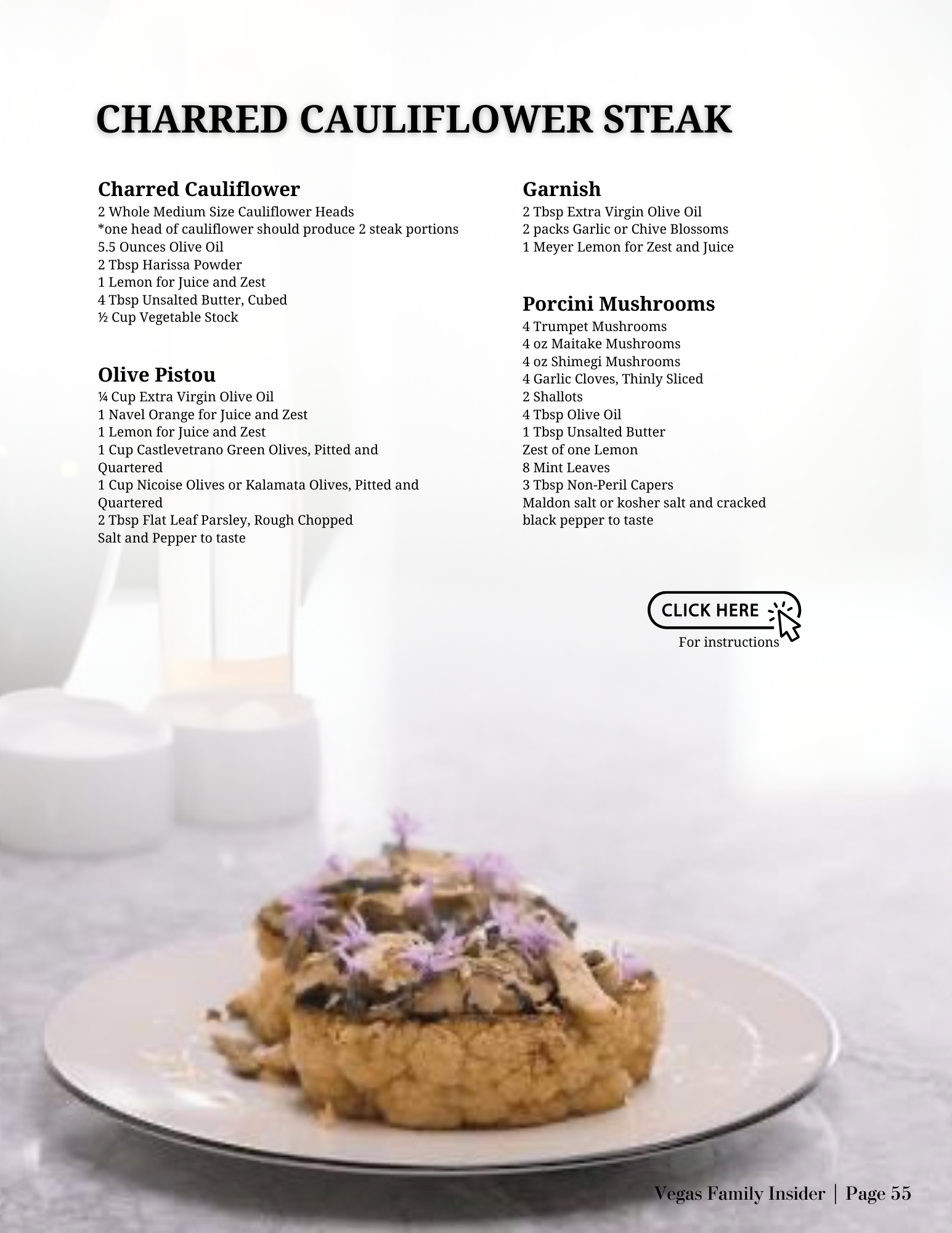
CHARRED CAULIFLOWER STEAK WITH OLIVE PISTOU, WILD MUSHROOMS
**Yields 4 Cauliflower Steak Portions
Charred Cauliflower
2 Whole Medium Size Cauliflower Heads
*one head of cauliflower should produce 2 steak portions
5.5 Ounces Olive Oil
2 Tbsp Harissa Powder
1 Lemon for Juice and Zest
4 Tbsp Unsalted Butter, Cubed
½ Cup Vegetable Stock
Olive Pistou
¼ Cup Extra Virgin Olive Oil
1 Navel Orange for Juice and Zest
1 Lemon for Juice and Zest
1 Cup Castlevetrano Green Olives, Pitted and Quartered
1 Cup Nicoise Olives or Kalamata Olives, Pitted and Quartered
2 Tbsp Flat Leaf Parsley, Rough Chopped
Salt and Pepper to taste
Porcini Mushrooms
4 Trumpet Mushrooms
4 oz Maitake Mushrooms
4 oz Shimegi Mushrooms
4 Garlic Cloves, Thinly Sliced
2 Shallots
4 Tbsp Olive Oil
1 Tbsp Unsalted Butter
Zest of one Lemon
8 Mint Leaves
3 Tbsp Non-Peril Capers
Maldon salt or kosher salt and cracked black pepper to taste
Garnish
2 Tbsp Extra Virgin Olive Oil
2 packs Garlic or Chive Blossoms
1 Meyer Lemon for Zest and Juice
METHOD
Charred Cauliflower
Preheat an oven to 325 degrees F.
The first step of trimming even cauliflower steaks is to peel the leaves off the cauliflowers. Take a chefs knife to cut the stem off leaving one inch left or enough for the flowerettes to stay intact and for the whole cauliflower to stand upright on the cutting board. This will leave the base flat and stable as well to cut into the cauliflower evenly. Wet your chefs knife liberally with water before cutting the steaks to make the knife slick and non stick when making contact with the inside of the vegetable. Cut off one inch off the left and right edge of the cauliflowers leaving about 2 inches of the center intact. Then slice the remaining portion in half, resulting in 2 each one thick steaks from each cauliflower. The more even the steak size results in a more even cook time.
Take a medium size sheet tray or glass baking pan and drizzle in about 4 ounces of olive oil. Sprinkle 2 tablespoons of harrisa powder and 2 pinches of maldon salt over the oil. Rub one flat side of the steaks in the olive oil/harissa mix and pour one ounce of olive oil and the remaining harissa powder over the unseasoned sides of the steaks. Finish with another two pinches of maldon salt. Continue to rub all the sides of the cauliflower in the oil/harissa mix until the steaks have absorbed an even amount of seasoning.
Heat two large cast iron skillets on medium high heat with one tablespoon (0.5 ounce) of olive oil each. Once the pans are smoking, place the steaks in the hot pan and let brown on one side for 90 seconds or until they begin to get char marks in the edges. Turn the steaks over gently, add 2 tablespoons of butter to each pan, melt and brown and give the steaks a nutty flavor. Baste the steaks with the browned butter. When the butter is frothy pour the vegetable stock equally into the pans and let it come to a boil. Remove the cast iron pans from the stovetop and place side by side on the middle rack of the oven. Roast in a 325 degree F oven for 8-10 minutes. Use a paring knife to test the doneness of the cauliflower. If the knife feels hard to stick into the steaks it needs to continue cooking. If it pushes into the flesh easily it is finished cooking. Remove from the pan and let rest.
Olive Pistou
In a medium size bowl mix the quartered olives with olive oil, orange juice, orange zest, lemon juice and lemon zest and parsley. Season to taste with salt and pepper. Set aside. This pistou is similar to an olive tapenade and like so can be made ahead of time and stored in glass jars or vacuum sealed bags and refrigerated for at least a month.
Wild Mushrooms
Heat a large saute pan on medium-high heat with two tablespoons of olive oil. Slice the trumpet mushrooms in quarter inch lengthwise slices and move to the side of the cutting board or into a bowl to reserve. Take the shallots, cut them in half lengthwise then turn them onto the cut side for stability and slice the shallots into semi thin julienne pieces.
Add the sliced porcinis to the hot saute pan and cook for 3-5 minutes to start coloring the mushrooms. Season the mushrooms with salt and pepper. Pour the sliced shallots and garlic into the pan and continue to cook, stirring occasionally for 5 minutes or until the shallots and garlic are translucent. Zest one lemon into the cooked mushroom mixture. Add the prepared olive pistou to the pan of cooked mushrooms and stir together. Turn the heat of the pan down to medium low. Chiffonade the mint thinly and sprinkle over the mushrooms. Sprinkle the capers into the mushroom mix and stir in to incorporate. Turn the heat off the pan and reserve. Season to taste with more salt and pepper if needed.
TO PLATE
For plating a side dish: Use a large metal spatula or spoon to pick up each cauliflower steak and place two steaks per plate with the core sides facing the center of the plates. Scoop a few heaping spoonfuls of the olive/mushroom mixture over the steaks. Finish plating by drizzling olive oil, zesting meyer lemon and squeezing the juice of one wedge of lemon over the steaks. Garnish with and randomly placing the garlic or chive blossoms with a plating tweezer all over the steaks.
For plating as an entrée: Place cauliflower steaks individually on 10 inch plates. Finish with saucing and garnishing the same as above.
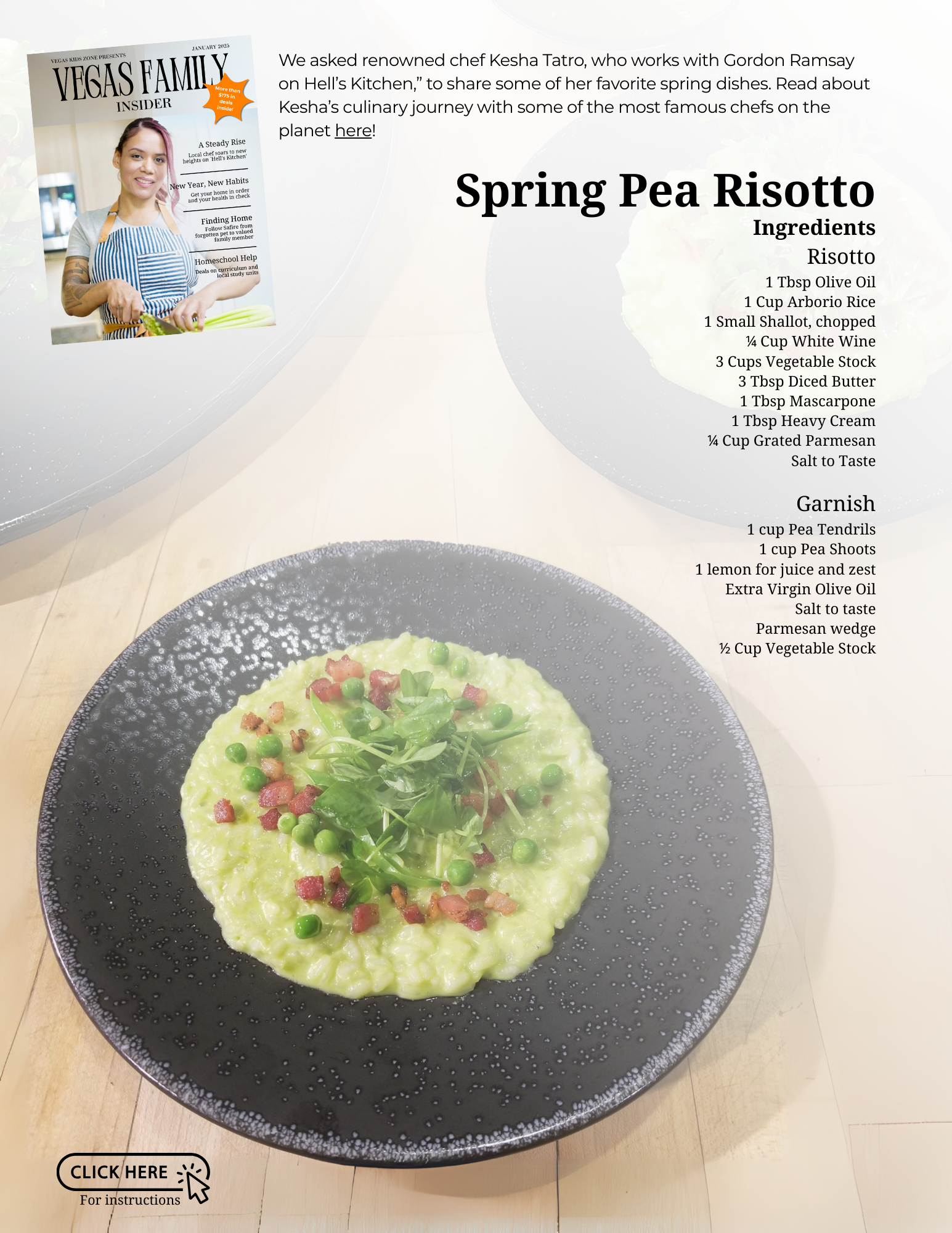
Spring Pea Risotto
Yields 4 portions
INGREDIENTS
Risotto
1 Tbsp Olive Oil
1 Cup Arborio Rice
1 Small Shallot, chopped
¼ Cup White Wine
3 Cups Vegetable Stock
3 Tbsp Diced Butter
1 Tbsp Mascarpone
1 Tbsp Heavy Cream
¼ Cup Grated Parmesan
Salt to Taste
Garnish
1 cup Pea Tendrils
1 cup Pea Shoots
1 lemon for juice and zest
EVOO
Salt to taste
Parmesan wedge
METHOD
Pea Puree
Bring a 1 quart sauce pot of salted water to a boil. Pour the peas into the water and cook until tender.
Strain and put into a blender and puree with knobs of butter and a few ice cubes to cool down the puree
quickly but keep the vibrant color and thin it out to a consistency that it can coat the back of a spoon
(nape). Strain into a bowl over an ice bath to chill so the peas don’t oxidize. Reserve for plating.
Risotto
Bring the stock to a simmer in a pan. Heat another medium saucepan and add a tablespoon of olive oil.
Stir in the rice and cook, stirring, for a minute to lightly toast. Add the chopped shallots and let it sweat
out. Pour in the wine and let it bubble to reduce down until the pan is quite dry. Gradually add the
stock, a ladleful at a time, stirring frequently. Let the rice absorb most of the stock in the pan before
adding another ladleful. Repeat process until rice is al dente (with just a small bite to it still).
When the rice is al dente, stir in 1 cup of pea puree, grated parmesan, mascarpone and heavy cream.
Add more pea puree to balance color and flavor. Adjust the seasoning if needed.
TO PLATE
Pour about 3 heaping spoonfuls of risotto into the center of the plate. Shake the plate lightly back and
forth to spread the risotto to cover the surface area of the plate. Pour more to fill in the gaps if needed.
Take the parmesan wedge and grate a liberal amount of the cheese on top of the risotto evenly with a
microplane.
Add the pea tendrils, pea shoots, zest of one lemon, squeeze a half a lemon and 2 teaspoons of extra
virgin olive oil to a mixing bowl and mix like a salad. taste and adjust with more lemon juice, evoo and
salt if needed. Mount the salad in the center of the finished risotto. Serve immediately