
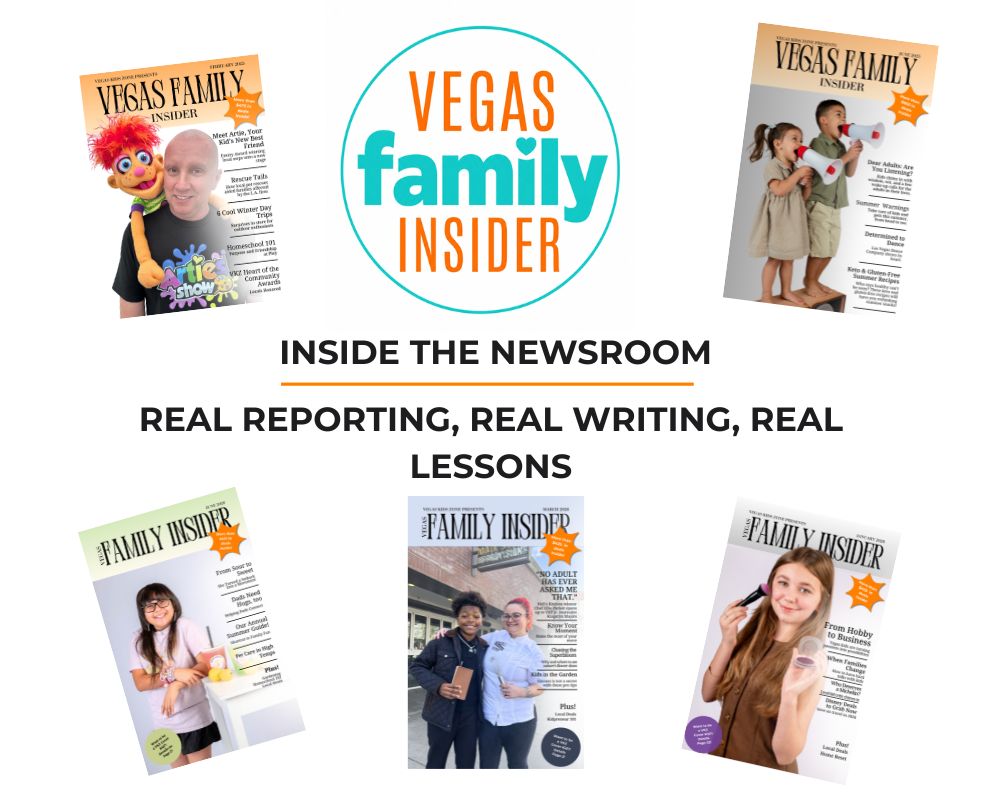
Want to know what makes people click on a story, keep reading, and remember it long after they’ve finished?
Welcome to Inside the Newsroom, a weekly feature from Vegas Family Insider where young journalists, aspiring writers, and curious readers learn how great reporting works.
Each week, we’ll break down a real-world news story, feature article, interview, or magazine piece and explore the techniques professional journalists use to capture attention, ask better questions, uncover meaningful stories, and connect with readers.
This is ideal for any student interested in journalism, a teen building writing skills, a homeschool family looking for media literacy resources, or a parent helping a young storyteller find their voice.
Inside the Newsroom isn’t about grammar worksheets or textbook exercises. It’s about seeing journalism in action.
Every week you’ll have the opportunity to learn:
- What makes a strong headline
- How reporters ask questions that uncover great stories
- Why some opening paragraphs hook readers instantly
- How photos can tell stories without words
- How journalists find the human story behind the facts
- Tips you can use in your own articles, interviews, school assignments, blog posts, and creative writing
Below, we’ll look at a real article and answer one simple question:
What makes this good reporting?
Let’s step inside the newsroom and find out.
This Week’s Jr. Journo Writing Tip
How Young Journalists Can Write a Strong News Lead
The lead has one main job: make the reader want the next sentence.
It should give readers a clear reason to care while pointing them toward the heart of the story. A good lead may open with a vivid detail, a surprising fact, a person in action, a problem or a moment that reveals what the story is really about.
Mediocre Lead vs. Stronger Lead
These are hypothetical examples based on a youth recycled-art class.
Mediocre lead
Kendra is teaching a class about making art from recycled materials.
Stronger lead
A cereal box, three bottle caps and yesterday’s newspaper may look like trash—until 12-year-old Kendra turns them into art.
Why the Mediocre Lead is, Well, Mediocre
This sentence is accurate and understandable. It tells us who and what, but it reads more like a calendar listing than the beginning of a story.
It does not yet give us:
* a picture we can see;
* a reason this class is different;
* Kendra’s age or perspective;
* a question we want answered; or
* a feeling that something is about to happen.
Why the Stronger Lead Makes You Want To Read
This version gives the reader specific objects to picture. It introduces contrast—trash versus art—and reveals that the teacher is only 12. It also creates curiosity: What will she make, and how will she teach other young people to see possibilities in things most of us throw away?
Why it is stronger:
Summarizes the event
Opens inside the idea
Uses broad language
Uses specific, visual details
Gives information
Gives information plus curiosity
Could describe many classes
Feels particular to this story
Tells us the topic
Begins to show us why it matters
The stronger lead is not better because it is longer or “fancier.” It is better because every detail is doing a job.
👉🏼The Lead Test
Before you keep writing, ask:
Is my most interesting or important information near the top?
Can the reader picture something?
Does this sound like a story rather than an announcement?
Is it accurate?
Does it make the reader want one more sentence?
One warning: a strong lead should create curiosity, but it should never trick the reader. If your opening promises drama, surprise or meaning, the rest of the story must deliver it.
Conventions on Our Assignment Radar
These events could lead to stories about fandom, pets, entrepreneurship, products, careers and the people behind big Las Vegas gatherings. Do not register, promise coverage or contact an event as a Vegas Family Insider reporter on your own. Tell us which opportunity interests you, and we will determine whether it fits our coverage and request media access when appropriate.
NOVEMBER 2026–FEBRUARY 2027
Big Questions, Great Stories: Las Vegas Events for Curious Kids
How does a drawing become a collectible toy? What does it take to perform on ice? How do young rodeo competitors prepare for a big event? Las Vegas is full of stories waiting to be told.
These upcoming conventions, performances and seasonal attractions offer family fun and potential reporting opportunities for Family Insider Jr. Journalists.
November 2026
SEMA Fest
A potential assignment for teens interested in music, automotive creativity and the work behind live events. The SEMA Fest concert is open to all ages.
Reporter’s question: What careers bring music and car culture together?
Access note: The all-ages policy applies to the concert. It does not establish access to the separate SEMA trade show.
Visit SEMA Fest →DesignerCon
Discover collectible toys, plush, illustration, apparel and independent design. This is a particularly exciting connection for our Mighty Moguls and young artists. Children 12 and under receive free admission with a paid adult.
Reporter’s question: How do you turn an original character or creative idea into a product people want to buy?
Potential assignment: Interview a toy designer or independent artist about their first creation and what they learned along the way.
Access note: Friday is VIP-only. Plan a general-admission visit for Saturday or Sunday, and arrange interviews in advance.
Explore DesignerCon →Sin City Anime
This all-ages convention brings together anime fans, voice actors, artists, cosplay and gaming.
Reporter’s question: Who are the creative people behind our favorite characters?
Potential assignment: Interview a voice actor, artist or cosplay maker about developing their skills and finding their creative community.
Access note: Select age-appropriate programming and request approval for youth interviews, filming and chaperone access.
Explore Sin City Anime →Elf The Musical
Buddy’s holiday adventure comes to the stage in a production recommended for ages 6 and older. A sensory inclusive performance is scheduled for November 25 at 2 p.m.
Reporter’s question: How do performers and theater teams make a show welcoming for more families?
Potential assignment: Pair a young reporter’s review with an approved cast interview or a conversation about sensory inclusive theater.
View Elf dates and details →December 2026
Cowboy Christmas
This free public event features western exhibitors and experiences, including the YETI Junior National Finals Rodeo. It offers a chance to explore craftsmanship, small businesses and the dedication of young competitors.
Reporter’s question: What does it take to prepare for a major rodeo competition while you are still a kid?
Potential assignment: Arrange a youth competitor interview through the organizer, or meet a maker who has built a business around western goods.
Access note: Cowboy Christmas admission is free. Confirm any separate rodeo seating, ticketing and interview arrangements.
Explore Cowboy Christmas →George Balanchine’s The Nutcracker
Nevada Ballet Theatre brings this holiday tradition to life with dance, costumes and imaginative storytelling. This production allows children ages 3 and older; every attendee needs a ticket.
Reporter’s question: How much practice and teamwork go into a holiday ballet?
Potential assignment: Request an interview with a dancer or production team member. Ask whether a student performer is available to share their experience.
View The Nutcracker dates and details →Glittering Lights
The holiday drive-through display offers a family outing and a possible story about the planning and production behind a large seasonal attraction.
Reporter’s question: How do you build a holiday light experience this big?
Access note: Request a separately arranged production interview. The drive-through visit itself offers limited interviewing opportunities.
Find Glittering Lights on the official calendar →January 2027
Disney On Ice: Jump In!
A family-friendly reporting opportunity that connects athletic training with character, music and performance.
Reporter’s question: How do skaters train to tell a story on ice?
Potential assignment: Request a performer interview about practice, touring and learning to skate. Ask whether an approved rehearsal or photo opportunity is available.
Access note: Youth interview participation and media opportunities must be approved by the show’s publicity team.
Find Las Vegas dates and tickets →Game On Expo
For families considering a dedicated trip, this regional convention features gaming, anime, tabletop games, guests and creative culture.
Reporter’s question: What goes into creating games and the communities around them?
Access note: Confirm youth admission, media eligibility and chaperone policies before planning a reporting trip.
Explore Game On Expo →The Outsiders
A stage adaptation that connects literature, friendship, identity and belonging. This is a potential assignment for teen reporters interested in books and theater.
Reporter’s question: How do you turn a well-known novel into a musical?
Content note: The venue recommends ages 10+, but the production includes themes of suicide, domestic abuse and violence, plus sensory effects. Parents should review the full show information before choosing this assignment.
View The Outsiders dates and content information →February 2027
Learning Disabilities Association Conference
LDACON64 brings together families, educators and professionals to explore specific learning disabilities, including dyslexia, dyscalculia and dysgraphia.
Reporter’s question: What do kids wish adults understood about how they learn?
Potential assignment: Request a supervised teen interview with an advocate, educator or speaker about learning differences.
Access note: This is a potential interview lead, not a confirmed youth outing. Minor attendance and youth media eligibility have not been verified.
Learn about LDACON64 →Hamilton de Holanda
The Brazilian mandolin musician began playing at age five. His performance offers an opportunity for music-loving kids to explore creativity, improvisation and musical traditions. Ticketed children ages 5 and older may attend.
Reporter’s question: How does a childhood interest become a musical career?
Potential assignment: Request a short interview about learning an instrument, practicing and sharing Brazilian music with the world.
View performance details →What About CES?
CES requires attendees to be at least 18 years old and affiliated with the consumer technology industry. It is not an under-18 Jr. Journalist field trip. Separately arranged virtual interviews with exhibitors could still offer stories about family technology, accessibility and inventions.
Read official CES registration requirementsThis Week’s Story Breakdown
Finding the Real Story Behind the Interview
This week, we’re studying two articles that could not seem more different.
One is a celebrity interview featuring Jennifer Garner.
The other follows investigators trying to uncover the source of a food-poisoning outbreak.
One has Hollywood, happiness and homemade Magic Shell. The other has lettuce, illness and a trail of evidence.
But both teach us the same important lesson:
A reporter’s job is not simply to gather information. It is to find the story hiding inside that information.
Story No. 1: Going Beyond the Celebrity Promotion
In an interview published by C.L. Gaber, Jennifer Garner is technically there to promote her latest television series, The Five-Star Weekend. Garner stars as Hollis Shaw, a food influencer navigating life after the death of her husband.
That is the reason for the interview—but it isn’t the entire story.
Gaber begins with something playful and familiar: Garner’s movie 13 Going on 30 and her recipe for homemade Magic Shell.
It is a smart opening for several reasons.
1. It gives readers something they can picture
Chocolate hardening over ice cream is visual. Readers can immediately see it, and probably taste it.
A strong lead often gives us an image, sound, action or feeling before it begins explaining the facts.
2. It introduces more than one side of the subject
Even if a reader doesn’t know Garner from her movies, the food connection may still pull them in. The opening quickly shows that she is an actor, producer, entrepreneur, cook, mother and someone with interests outside Hollywood.
When interviewing someone well known, don’t rely entirely on the fact that they are famous. Give every reader a reason to care.
3. It creates a bridge to the deeper subject
The food discussion connects naturally to Garner’s character, a food influencer who is grieving the loss of her husband.
From there, the interview moves into Garner’s personal thoughts about grief, happiness, friendship and the experiences she brings to the role.
This is where the interview becomes more than promotion.
The reporter includes the information readers need about the television series, but she also reaches the “meaty stuff”: what Garner believes, what she has experienced and what the role means to her.
The lesson for young writers
Sometimes you will interview someone because they have something temporary to promote:
- A new show
- An upcoming performance
- A grand opening
- A book release
- A community event
- A new product or business
You still need to mention that news. It answers the important question: Why are we interviewing this person now?
But the promotion should not take over the entire conversation.
Your job is to look for the larger story.
Ask yourself:
- What can this person talk about that will still be interesting after the event is over?
- What has this experience taught them?
- What does the public not already know about them?
- What emotion or personal experience is underneath the project?
- Why should someone care—even if they never watch, attend or purchase what is being promoted?
That is how an interview becomes a story instead of an advertisement.
A Strong Ending Looks Back
Gaber closes the interview by returning to several ideas introduced earlier: Garner’s movies, her love of food and the difference between her actual age and the age she feels inside.
Garner is 54, but parts of her still feel 30.
That is a lovely nod back to 13 Going on 30—and it gives the story a satisfying sense of completion.
Writers call this a callback or a circular ending. The ending echoes something from the beginning, showing readers that the writer knew where the story was going all along.
A good conclusion doesn’t have to announce, “In conclusion…”
In fact, please don’t. Your editor may suddenly develop a mysterious eye twitch.
Instead, return to an image, question, quote or idea from your opening and show readers what it means now.
Story No. 2: Reporting as Detective Work
A New York Times story here takes readers behind the investigation of a food-poisoning outbreak linked to lettuce.
This is a completely different type of reporting.
The reporters are not primarily trying to reveal someone’s personality. They are trying to explain a process:
How did investigators take reports from sick people and trace them back to a shared source?
This kind of story shows why reporting can feel a lot like detective work.
Investigators must:
- Interview people about what and where they ate
- Look for details the cases have in common
- Compare dates and locations
- Examine restaurant and supplier records
- Trace ingredients through distributors and farms
- Test theories against physical and scientific evidence
- Rule out explanations that don’t fit the facts
The first clue is not always the final answer.
A person may remember eating a taco but forget the shredded lettuce inside it. Several meals may look completely different until investigators discover that they all contained the same ingredient.
That is why good reporters don’t stop at the first obvious answer.
They keep asking:
- What do these cases have in common?
- What evidence supports that conclusion?
- What information is still missing?
- Who can confirm it?
- Is there another possible explanation?
- How certain are the investigators?
- What should readers know right now?
The food-poisoning investigation also offers a strong example of turning complicated information into a story readers can follow. A reporter must understand the science and the timeline and then explain them without making the audience feel as though it has accidentally wandered into a graduate seminar.
This Week’s Newsroom Tip
Find the thread.
Before you begin writing, finish this sentence:
“This story is really about…”
A celebrity interview may appear to be about a television show, but it may really be about grief, friendship or growing older.
A public-health story may appear to be about lettuce, but it may really be about the painstaking work required to protect people when one contaminated ingredient travels through a complicated food system.
When you know what the story is really about, you can decide:
- What belongs in the opening
- Which quotes deserve the most space
- What background readers need
- Which details can be removed
- How the story should end
Reporter Challenge
Choose one person you would like to interview who has something to promote.
It could be an actor, athlete, musician, business owner, author, performer, community leader or kidpreneur.
Write five questions:
- One question about what the person is promoting
- One question that asks for a personal story
- One question about a challenge or difficult experience
- One question that begins with “Why” or “How”
- One unexpected question that could reveal something readers don’t already know
Then write one possible opening that does not begin with the person’s name, title or résumé.
Send your questions and opening to Kim@VegasFamilyInsider.com for feedback or a future Reporter Points challenge.
Previous In the Newsroom Articles
This Week’s Writing Challenge: Can a Buffet Tell the Story of America?
Hey Jr. Journalists!
This week, I want you to read like a reporter.
The Associated Press recently published an article about… buffets. Read it here: After helping the US win the Cold War, the all-you-can-eat buffet is fading. Thanks, COVID.
I know.
At first glance, that sounds about as exciting as writing a report about toast.
But then the reporters did something really smart.
Instead of saying, “Buffets are popular,” they opened by taking readers back in time.
They found a newspaper clipping from 1946 describing the opening of the first Chuck Wagon buffet at El Rancho on “a cool fall evening after the conclusion of World War II.”
Think about that for a second.
In fewer than a dozen words, you’re suddenly standing in Las Vegas nearly 80 years ago. That’s the power of great writing.
The article keeps digging. It explores who else claims to have invented the buffet, how Las Vegas turned inexpensive buffets into a legendary attraction for gamblers and locals, how COVID changed the buffet industry forever, and why some experts believe buffets will never truly disappear.
It isn’t just about food.
It’s about history.
It’s about culture.
It’s about how one simple idea changed over time.
Let’s Think Like Journalists
As you read stories this week, ask yourself:
- Why did the reporter choose this opening?
- What made you want to keep reading?
- What is the real story hiding underneath the obvious one?
- What do you think was the purpose of this article?
- Was it trying to inform? Entertain? Make readers nostalgic? Preserve history?
- Was there anything missing that YOU would have included?
Family Conversation
Now ask your family!
- Do you remember going to buffets?
- Did your family ever go to Sweet Tomatoes?
- Do you still visit places like Golden Corral or casino buffets?
- What’s your favorite buffet memory?
- If buffets disappeared tomorrow, would anyone in your family care?
Sometimes the best interviews happen around the dinner table.
Your Assignment
Imagine YOU were assigned this story.
What angle would you take?
Maybe you’d interview:
- a chef
- grandparents who remember old Las Vegas
- families who loved Sweet Tomatoes
- casino visitors
- kids who have never experienced a buffet
Could your version be even more interesting?
Why This Is a Strong Lead
Las Vegas Review-Journal reporter Bryan Horwath explored the personal and legal trauma that can follow an accident. (Full article here.)
“For Rogelio Vidal, life changed forever during his morning commute to a job site on May 15.”
DUI has been written about so much, it may get glanced over. For this piece, notice what the writer does not do.
He doesn’t lean on statistics.
He doesn’t begin with police reports.
He starts with a person.
Immediately, we meet Rogelio Vidal, and we’re told something dramatic happened that changed his life forever. That creates curiosity and makes us want to keep reading.
The writer then takes us step-by-step through the event. We learn where Vidal was, what time it happened, and how the crash occurred. Rather than simply telling us the facts, the reporter places us in the truck with him.
When discussing the actual crash, the quote, “I felt the hit from the back,” adds emotion and authenticity. We aren’t just hearing about the accident; we’re hearing from the person who experienced it.
Another reason this lead works is because the most important detail is intentionally delayed. The writer doesn’t immediately tell us Vidal lost his hand. Instead, the story builds tension. We follow Vidal through the crash, the confusion, and the realization that something is terribly wrong. Only then do we learn that doctors had to amputate his hand.
This keeps readers engaged because they are experiencing the story as Vidal experienced it.
The lead is made up of 5 short paragraphs and helps us understand why this story matters. This isn’t just a crash story. It’s about a hardworking Las Vegas painter whose life and livelihood changed in an instant.
Great reporters don’t simply report what happened.
They help readers understand why it mattered to someone.
Questions for Jr. Journalists
- What made you want to keep reading after the first sentence?
- What information did the writer save until later?
- How would the story feel different if it started with police information instead of Rogelio?
- What emotion did you feel while reading?
- What is the real story here: the crash, the DUI driver, or Rogelio’s future?
👉🏽 List of Potential Interviews for Vegas Family Insider Jr. Journalists
Rick Harrison — Founder, Pawn Stars / Entrepreneur
Paolo Tiramani — Founder & CEO, BOXABL
Broadway Touring Cast Member — Lead Performer, National Broadway Tour
FIRST Robotics Competition Team Captain — Student Robotics Leader
Nancy Brune — Las Vegas City Councilwoman
Summer Middleton — President, LeTip of Las Vegas
Douglas Kay — General Manager, Fantastic Indoor Swap Meet
Lori Karbel — Certified Mentor, SCORE Las Vegas
Documentary Filmmaker — Director/Producer
Anna Gomes — Founder, Loaded Empanadas
School Superintendent — Public Education Leader
Tricia Kean — News Anchor, KTNV Channel 13
Kalyna Astrinos — News Anchor, FOX5 Vegas
Nevada State Legislator — State Senator or Assemblymember
Museum Director — Executive Director, Local Museum
Las Vegas Lights FC or Las Vegas Aviators Player
Published Children’s or Young Adult Author
Chef/Restaurant Owner — Local Culinary Entrepreneur
Nonprofit Founder — Community Impact Leader
Who Should We Interview?
We’ve already started building an incredible list, but I want YOUR ideas, too.
Here are a few interviews we’re working toward:
- Rick Harrison (Pawn Stars) (Sign ups for the tour and in-person interview in late August or early September are still open)
- Flavor Flav and the SHE Weekend team (completed)
- Broadway performers visiting The Smith Center
- BOXABL
- Video game designers
- Police officers
- Park Rangers
- NASA speakers
- Local elected leaders
- Museums
- Behind-the-scenes tours of businesses
Now it’s your turn…
Who do YOU want to interview?
Seriously.
Send me names.
No idea is too big.
Sometimes all it takes is asking.
What Could You Write?
Not every story has to be an interview.
Maybe you’d rather write…
- A review of your favorite restaurant
- A new playground you discovered
- The best hiking trail for families
- A LEGO creation you’re proud of
- A book recommendation
- A movie review
- A gaming review
- An interview with your grandparent
- A “Day in My Life”
We Need More Than Writers
Not everyone loves writing.
That’s okay.
Maybe you’re a…
- Photographer
- Videographer
- Illustrator
- Podcast host
- Video editor
- Social media creator
Every newsroom needs different talents.
Remember…You’re not just learning how to interview.
You’re learning how to listen.
You’re learning how to ask better questions.
You’re learning confidence.
And you’re helping other families discover amazing people and opportunities across Las Vegas.
I can’t wait to see what YOU come up with next.
Reply to this email with:
⭐ Someone you want to interview
⭐ A story idea
⭐ Or something you’ve always wondered about.
See you in the newsroom!