
By Caitlyn Paxman, OTR/L
For many people, horses are associated with recreation, competition, or simply the joy. Horses can also play an important role in healthcare. Hippotherapy is a specialized treatment approach that uses the movement of a horse as a therapeutic tool to help individuals work toward specific functional goals.
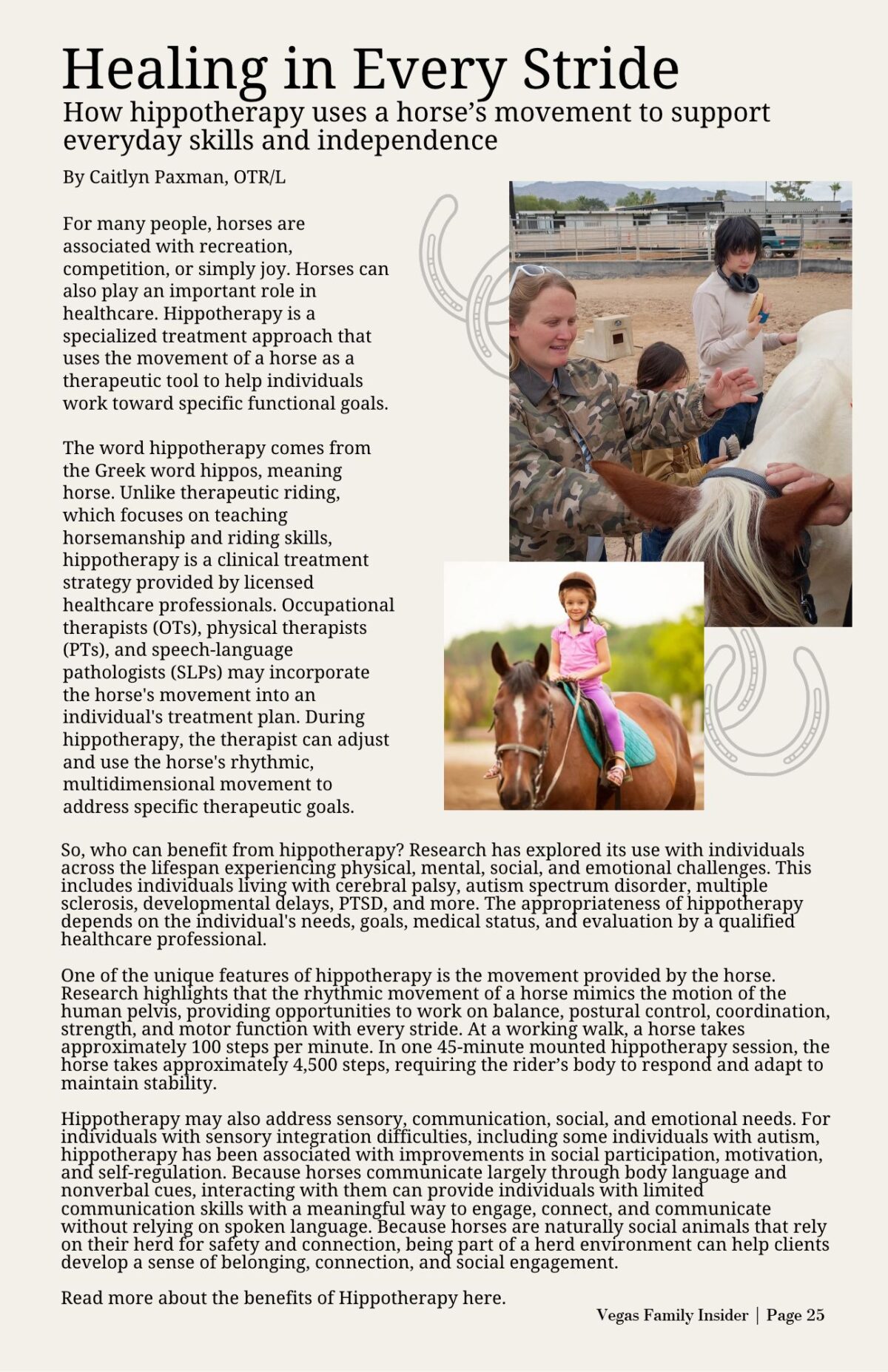
The word hippotherapy comes from the Greek word hippos, meaning horse. Unlike therapeutic riding, which focuses on teaching horsemanship and riding skills, hippotherapy is a clinical treatment strategy provided by licensed healthcare professionals. Occupational therapists (OTs), physical therapists (PTs), and speech-language pathologists (SLPs) may incorporate the horse’s movement into an individual’s treatment plan. During hippotherapy, the therapist can adjust and use the horse’s rhythmic, multidimensional movement to address specific therapeutic goals.
So, who can benefit from hippotherapy? Research has explored its use with individuals across the lifespan experiencing physical, mental, social, and emotional challenges. This includes but is not limited to individuals living with cerebral palsy, autism spectrum disorder, multiple sclerosis, developmental delays, PTSD, and more. The appropriateness of hippotherapy depends on the individual’s needs, goals, medical status, and evaluation by a qualified healthcare professional.
One of the unique features of hippotherapy is the movement provided by the horse. Research highlights that the rhythmic movement of a horse mimics the motion of the human pelvis, providing opportunities to work on balance, postural control, coordination, strength, and motor function with every stride. At a working walk, a horse takes approximately 100 steps per minute. In one 45-minute mounted hippotherapy session, the horse takes approximately 4,500 steps, requiring the rider’s body to respond and adapt to maintain stability.
Hippotherapy may also address sensory, communication, social, and emotional needs. For individuals with sensory integration difficulties, including some individuals with autism, hippotherapy has been associated with improvements in social participation, motivation, and self-regulation. Because horses communicate largely through body language and nonverbal cues, interacting with them can provide individuals with limited communication skills with a meaningful way to engage, connect, and communicate without relying on spoken language. Because horses are naturally social animals that rely on their herd for safety and connection, being part of a herd environment can help clients develop a sense of belonging, connection, and social engagement.
Occupational therapists have a particularly valuable role in hippotherapy because OT focuses on helping people participate in meaningful everyday activities. An OT can use the horse’s movement and the surrounding environment to address functional goals related to self-care, productivity, leisure, communication, regulation, and independence. Caring for and participating in the daily care of a horse can provide clients with a sense of routine, responsibility, and leadership skills. The horse’s presence may help reduce anxiety and promote relaxation, with the horse’s slower heart rate potentially supporting synchronization with a client’s heart rate and creating a sense of safety. Rather than simply teaching someone how to ride, the therapist uses the horse and its movement as a means of helping the individual achieve meaningful connection through herd mentality approaches.
For those interested in learning more or getting involved, the American Hippotherapy Association (AHA) provides education and resources related to hippotherapy for healthcare professionals. Individuals interested in receiving hippotherapy can also speak with their physician, OT, PT, or SLP to determine whether this type of treatment may be appropriate for their needs.
Hippotherapy represents a unique connection between healthcare, meaningful activity, and the movement of the horse. As an emerging area of practice, continued research and education will help expand understanding of how this approach can support participation, independence, and quality of life.
“There is something about the outside of a horse that is good for the inside of a man.”
-Winston Churchill